

Step 2 Identify leverage points

Leverage points are the places in a system where a small change can have large effects on the rest of the system.
Image from Betley, E., Sterling, E., Akabas, S., Gray, S., Sorensen, A., Jordan, R., & Eustice, C. (2021). Modeling links between corn production and beef production in the United States: A systems thinking exercise using mental modeler. Lessons Conserv, 11, 26-32.
Take your system map and try to identify areas where small changes can lead to significant impacts.
Consider diverse relationships, scales, and potential for intervention. Try to make a list and write these out. At this stage it is mostly about getting as many potential leverage points written down.Next, look for common causes and root causes in the list of potential leverage points.
Experiment with different systems thinking models.Try to visualise your system in new ways using system mapping. See the image below and click on it for a more detailed explanation.
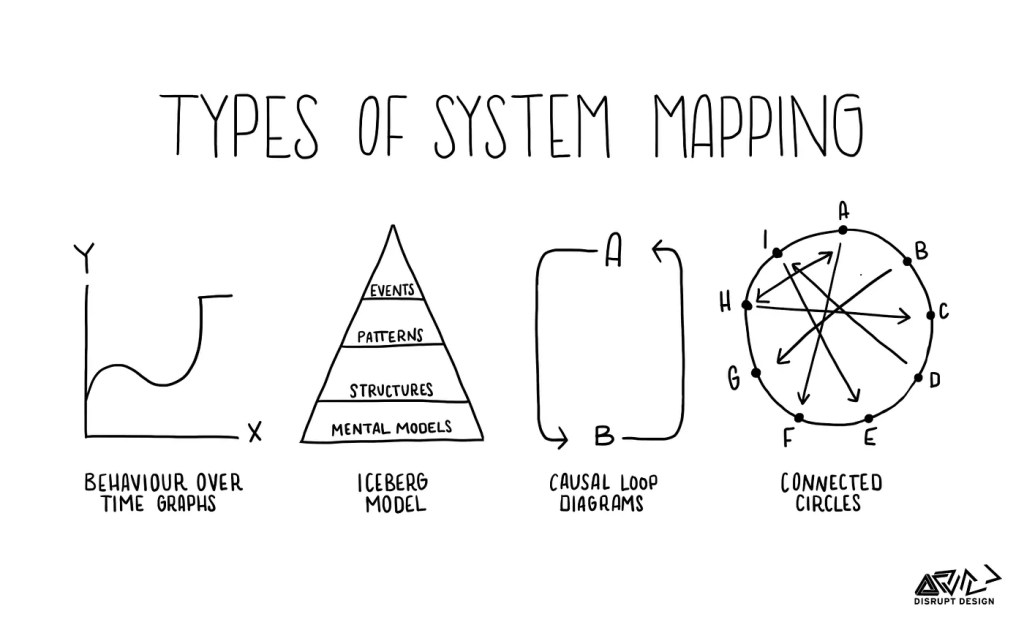
Use these visualisations and your list to look for bottlenecks, feedback loops, and system interdependencies. Explore areas with broken information flows or invisible influences.
Use the following three criteria for spotting and pinpointing the key leverage points in your system.
(1) common cause to multiple effects that can accelerate or decelerate the operation of a system.
(2) can be influenced by an intervener.
(3) root cause characterised by being independent (i.e., cannot cite further causes).
For your final list of key leverage points try to settle for at least 2 and a maximum of 5 points.
Don’t worry about these being the perfect and set in stone leverage points. If necessary you can always find and replace a leverage point later in the process. However, it is useful to have an idea of the best points to intervene for the following steps.
It will be important to save and use your final leverage points for the next steps in the process.
 Ecosystem Biomimicry Guide